
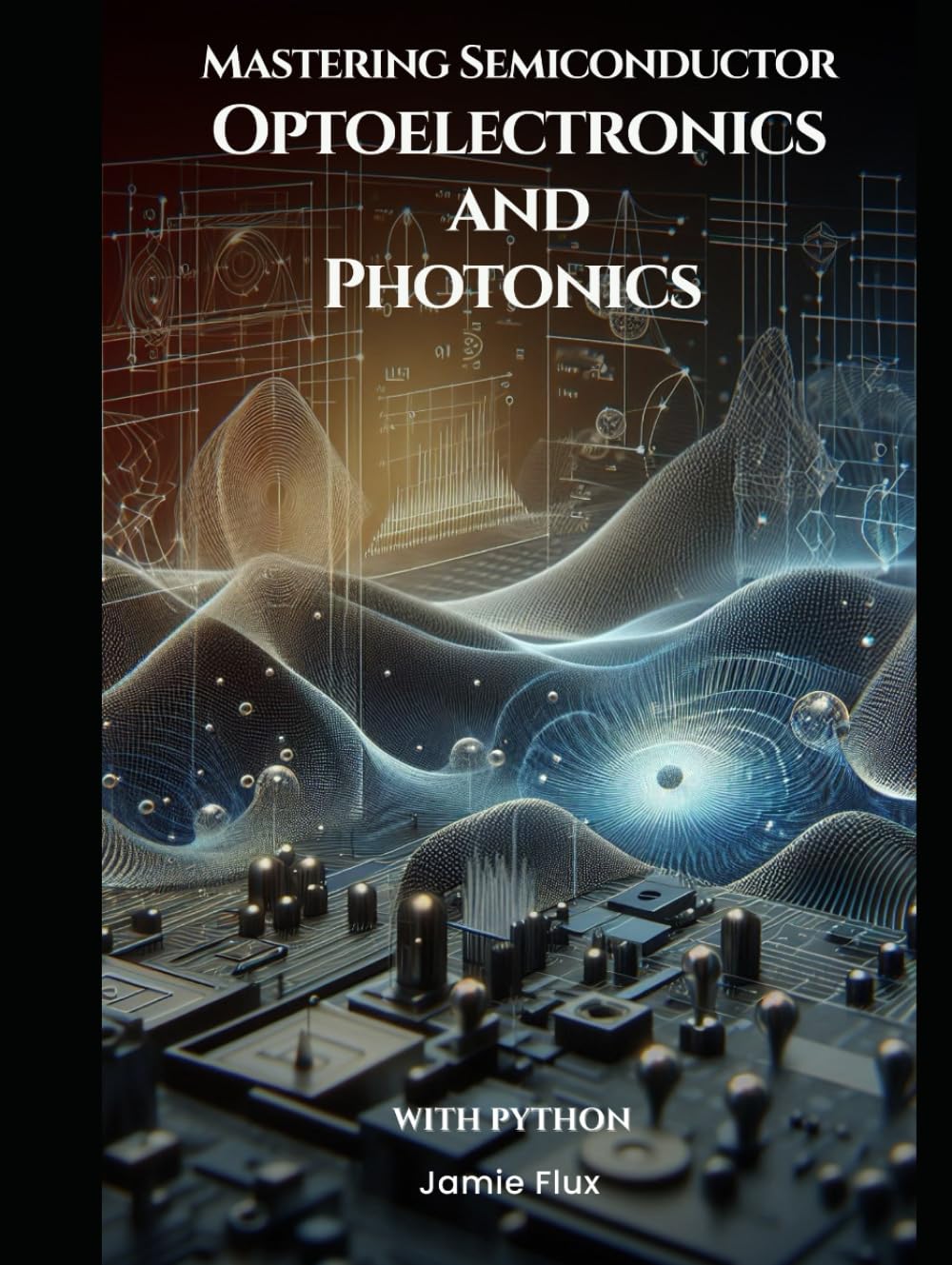
Mastering Semiconductor Optoelectronics and Photonics (Engineering the Future with Python: Semiconductors)
Produktdetails
| Artikelnummer | 220514551 | Erscheinungsdatum | 2026/05/03 | Listenpreis | €40.00 | Modellnummer | 220514551 | ||
|---|---|---|---|---|---|---|---|---|---|
| Kategorie | |||||||||
Navigate the intricate landscape of semiconductor optoelectronics and photonics with ease and confidence. This guide serves as your ultimate companion, demystifying complex theories and equipping you with the tools to apply these concepts in practical scenarios. Each chapter is enriched with Python code, providing hands-on experience and empowering you to experiment and innovate.Key Features:- In-depth exploration of core concepts and advanced topics in semiconductor optoelectronics and photonics- Practical Python code examples accompanying each chapter to reinforce key principles- Step-by-step explanations suitable for both beginners and seasoned professionals- A holistic view bridging physics, engineering, and real-world applicationsWhat You Will Learn:- Grasp the fundamentals of quantum mechanics through the Schrödinger Equation- Master electrostatics with the Poisson Equation in semiconductor contexts- Decode Maxwell’s Equations and their impact on photonics- Analyze light propagation using the Wave Equation- Understand electrical conductivity with the Drude Model- Apply the Kubo Formula for optical conductivity calculations- Explore band structure calculation using the Kronig-Penney Model- Design photonic devices with E-k Diagrams- Delve into the mathematics of PN Junction Equation- Utilize Fermi-Dirac Statistics for electron and hole distributions- Minimize reflections utilizing Brewster's Angle Equation- Implement Snell's Law in optical design- Apply Bragg's Law in photonic crystals- Analyzing absorption using the Beer-Lambert Law- Investigate thin-film optics with the Transfer Matrix Method- Simulate electromagnetic waves using the Finite-Difference Time-Domain Method- Explore multi-quantum well structures- Model semiconductor lasers with Rate-Equations- Uncover interaction dynamics with Coupled-Mode Theory- Use Green’s Functions in optical waveguide analysis- Model solitons with Nonlinear Schrödinger Equation- Enhance photonic systems with Optical Transfer Functions- Harness computational power with Yee’s Algorithm- Calculate Quantum Efficiency in photonic devices- Understand material properties with Complex Refractive Index- Explore optical switching mechanisms using Kerr Effect Equation- Apply Van Roosbroeck Equations in charge carrier analysis- Optimize amplifier performance with Optical Gain and Loss Calculations- Explore photon interactions using Einstein Coefficients- Master interface optics with Fresnel Equations- Model LED operations through Rate Equations- Analyze interferometry with Sagnac Interferometer Equations- Apply Mie Scattering Theory in particle analysis- Manage radiation energy with Planck’s Law- Calculate photonic bands with Transfer Matrix for Photonic Crystals- Design efficient amplifiers with Modal Gain in Semiconductors- Moderate light patterns using Diffraction Grating Equations- Explore Quantum Dot behavior and applications- Apply Tight-Binding Approximation for electronic modeling- Define optical paths with Optical Path Length Calculations- Analyze wavefronts via Huygens' Principle in Photonics Read more
| ISBN13 | 979-8338162286 |
|---|---|
| Language | English |
| Publisher | Independently published |
| Dimensions | 8.25 x 1.05 x 11 inches |
| Item Weight | 2.33 pounds |
| Print length | 381 pages |
| Part of series | Engineering the Future with Python: Semiconductors |
| Publication date | September 3, 2024 |
Korrektur der Produktinformationen
Wenn Sie Unvollständigkeiten oder Fehler in den Produktinformationen auf dieser Seite bemerken, nutzen Sie bitte das Korrekturformular unten.
KorrekturanfrageKundenbewertungen
Für dieses Produkt liegen derzeit keine schriftlichen Bewertungen vor.